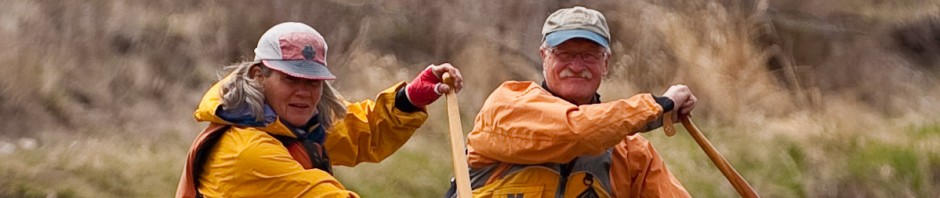
We are recently back from our latest northern paddling expedition – a 28-day descent of the Natla and Keele Rivers in Canada’s Northwest Territories, just south of the Arctic Circle. There were seven of us – MP and me, Lee James, Jeff and Molly King and Joth and Louise Davis. We all drove almost 5,000 miles round trip to Mayo, Yukon and back in order to avoid commercial flights and to use our own canoes and gear, an epic and also beautiful drive north. We paddled hard-shelled, traditional canoes outfitted with fabric spray decks. As has been our style ever since retirement, we gave ourselves lots of time cushion in the itinerary to enjoy the country, indulge rest days, and dawdle. Turns out that was a good thing.
After four long days of driving, we arrived at the float base in Mayo ready to leave cars behind and start our immersion. As often happens, circumstances evolved at the start due to plane availability, weather and so on. Four of us ended up flying in to the put-in that first night, landing on O’Grady Lake on a beautiful arctic evening. We were ebullient to be there, surrounded by tundra and mountains in a sweet camp, perched at the start. The other three came in the following morning and we ended up spending another two days there gearing up, enduring a rainy day and preparing ourselves.
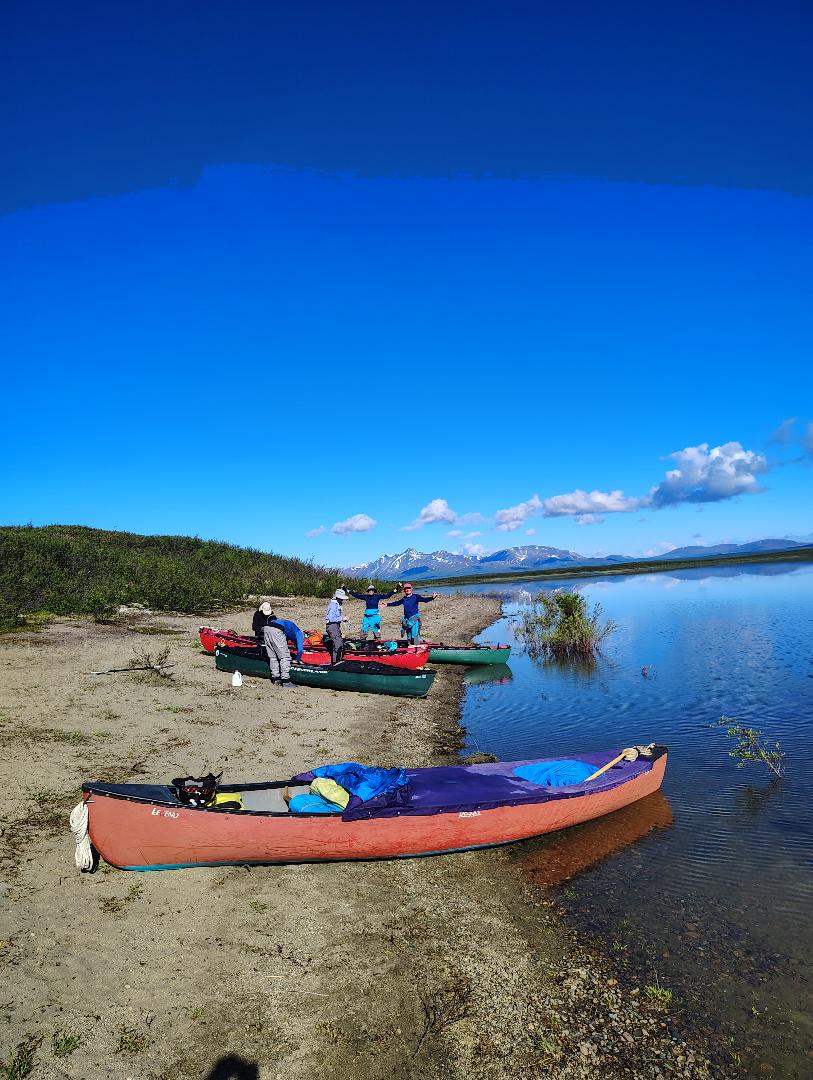
The third morning we geared up, paddled across the lake, and began our introduction to the Natla River. We had researched the trip with canoe reports and videos that all reported Class II – III rapids. What we found instead was a river both technical and pushy, full of rocks and also very high volume, producing consistently Class III rapids with quite a bit of solid Class IV mixed in for spice. Within a few miles we were emphatically disabused of our assumptions about a challenging but doable river and faced anxiety-ridden days that felt much more like survival. The first 25 miles of the Natla took us a week. Most of the travel days we managed 3-4 exhausting miles featuring protracted scouting, a lot of rigorous lining on slippery and treacherous shoreline, and very cautious running/sneaking of the continuous whitewater. Even at that, we had spooky times in rapids that threatened to swamp or capsize us. It was a river that if you swam, it would be really bad, because one rapid blended immediately into the next. The loss of a boat and very consequential swims were real dangers. Several times after those long days we gave ourselves rest days. Physically and emotionally pretty trying stuff – repeated falls, twisted ankles, bruised bodies. Especially considering that all of us are north of 70 years old.
The good news is that once we understood what we were up against, we adapted and adopted a very safe, cautious, careful travel style. There was some measure of satisfaction in the fact that we had the skills, experience and judgement to safely navigate in such conditions. It was slow, it was maddening, it wasn’t what any of us had signed up for, but we were handling it. The other solace was that we ran into a group of Canadians doing the same trip. Several of them had run the Natla a couple of years earlier and they were shocked by the current conditions. They were struggling as much as we were and said that the river was nothing like what they had encountered before. It turns out, we later found out from a local outfitter, that the Natla/Keele watershed was at a 30-year high water level and that we rode the crest of that. It’s illustrative of the fact that we were consumed by the challenge that we have no photos of that part of the trip.
The Natla gave us a 40-mile reprieve after the first week with a stretch of fast, but runnable water. Then we faced the final obstacle in the five-plus-mile Stelfox Canyon above the confluence with the Keele. Another punch in the face, involving a portage, more lining, more careful sneaking, consequential whitewater. One canoe capsized in that section, but we were lucky. Several boats waited below and were able to help get the overturned boat and swimmers to shore before the next whitewater was upon us. It took us three days (one a well-deserved rest day) to manage that and finally arrive at the confluence with the Keele, having spent more than two weeks navigating a river that under normal conditions could be run in an easy week.
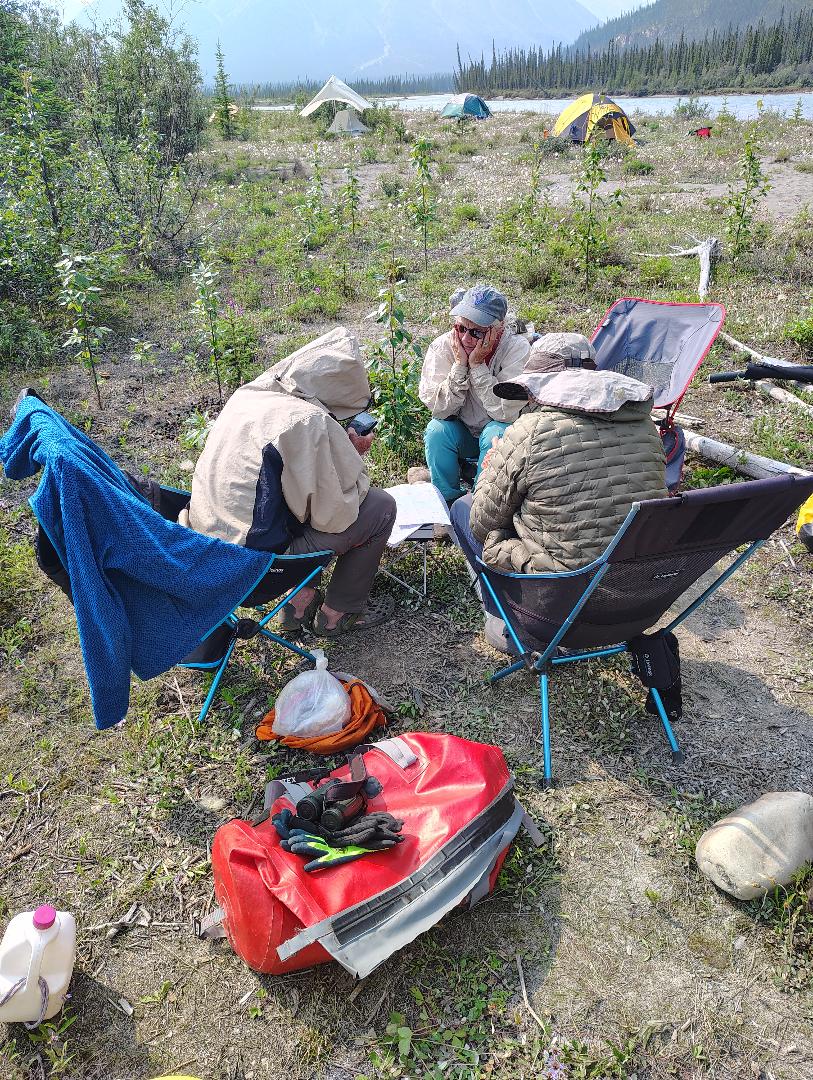
At the Keele we regrouped, spent an extra day, considered our options. The other factor that weighed on us was the threat of forest fires. We had several days of dense smoke that we didn’t know the source of, and had information that there were at least two fires burning on both sides of the Keele lower down. Fires have become a very real danger on these northern trips – they burn in remote terrain and unless they threaten a community, they aren’t fought. The prospect of paddling the gauntlet of flames was a very real concern and we had little information to base our expectations on. The confluence of the Natla/Keele was the only spot we could negotiate a pickup before the end. Several long and weighty discussions ended with Joth and Louise electing to fly out and head home, while the rest of us decided to take the risk of continuing.
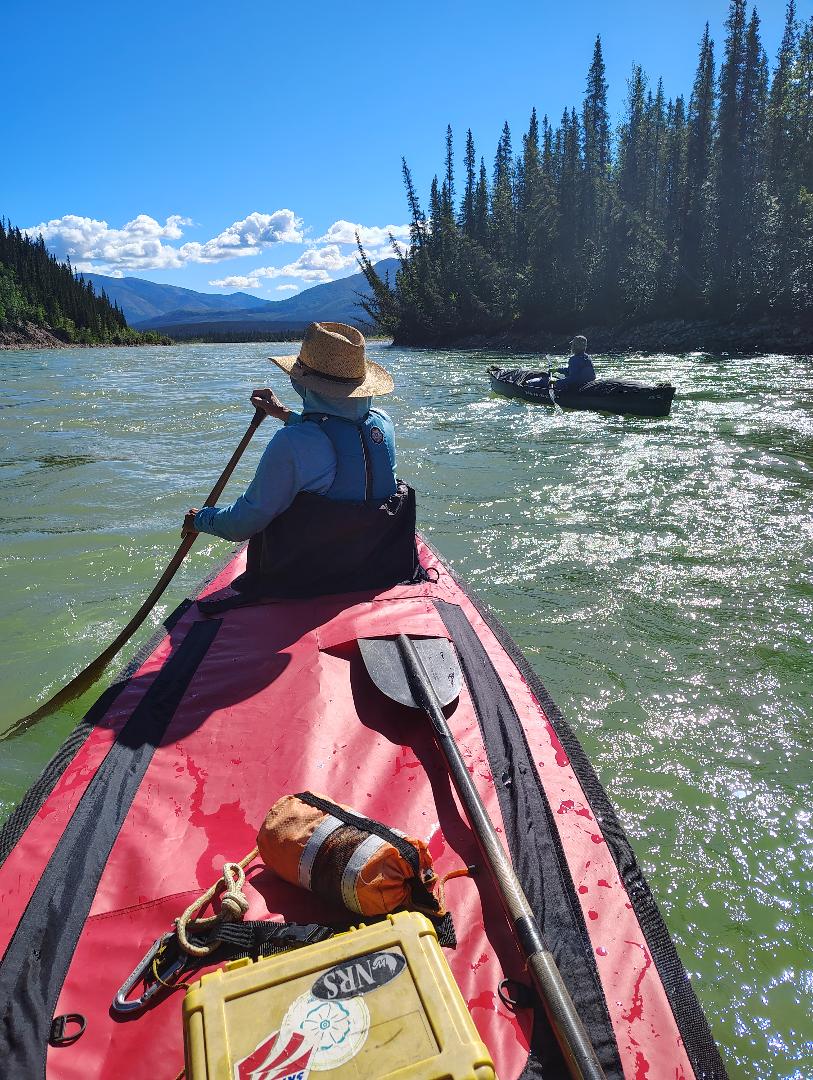
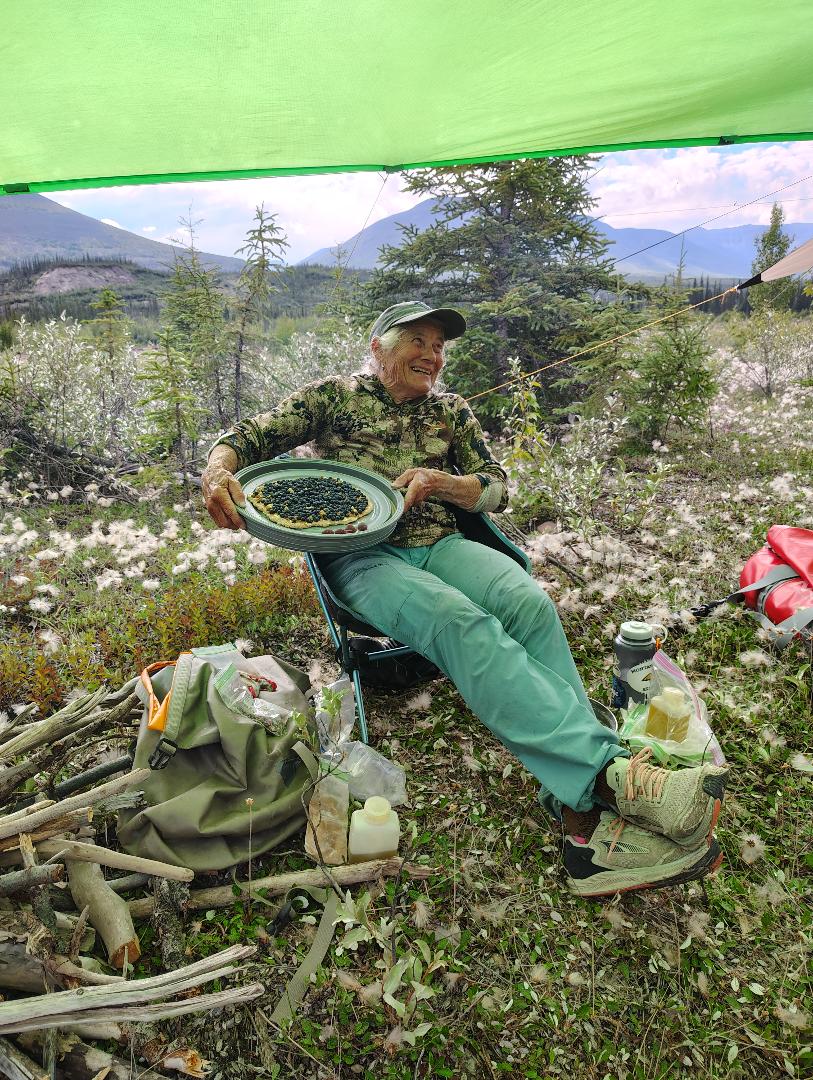
The next morning, we said our regretful goodbyes, rejiggered gear, and the five of us paddled off on the new, enlarged watershed of the Keele. Turned out to be that pat on the back we hoped for. We enjoyed a series of beautiful paddling days – easy going, fast current, stunning mountain scenery, pleasant camps, relaxed days where we still managed 25-35 river miles. Fires were never a threat, and most days didn’t have smoke either. So sweet, and such a payoff after the stress and danger of the Natla. Down we went, big swatches of river, several pleasant layover days, such a treat. The only caveat was the final paddling day to reach the confluence with the Mackenzie River, which ended up being a gusty, rainy day with conditions steadily deteriorating. Our final camp on the rocky shoreline of the Mackenzie featured terrible tent sites, howling winds, whitecaps on the river, and frigid conditions.
Rather amazingly, after a thirty-degree night and with gusty winds still building, our bush pilot made it on schedule and flew us all back to Mayo as planned. Another one in the books. Fraught. Often scary. Dangerous . . . Beautiful. Serene. Satisfying. In short, a little schizophrenic. Not at all what we expected. But really glad to have it behind us, and pretty proud of our accomplishment. And as always, the question . . . do we have another one of these in us???