Gems in plain sight. Overlooked, unnoticed, disregarded, places that we go by routinely and think nothing of, that hold jewels of habitat and unexpected power literally right under our noses.
For decades when I lived in Bozeman I made a yearly spring habit out of paddling the upper reaches of the East Gallatin River. It runs right through town, past golf courses and townhouses, under roads, next to the interstate highway, pearling along in view of thousands of residents and commuters. No one went there. Certainly no paddlers. The occasional homeless person set up camp along the bank, off the urban radar. Once in a while an angler might stand on shore, but the river carried no boats. No one paddled the bends, negotiated the logjams, noticed the yearly changes wrought by current and gravity, or appreciated the wildlife that never got the memo. It was, in its unassuming way, wild as all get out. Every year I’d set the canoe in at some unsanctioned spot, ride a bike shuttle to the next unsanctioned spot downstream, and run the stretch, discovering stuff along the way, encountering new challenges, reveling in expected logjams that had been removed by floods, riding down new channels cut through oxbow bends, startling golfers setting up a putt, and observing deer, geese, ducks, hawks, cranes, beavers all doing their thing oblivious to the surrounding hubbub of civilization. Such a sweet discovery and a delicious reminder of the hidden pockets of quietly beautiful and robust country lying there for everyone to see, if they bother to look. Over a forty year span, I paddled various sections of that little flow hundreds of times.
That discovery put me in the habit of looking for and seeking out similar spots. I’ve certainly missed dozens of opportunities, but I’ve also founds other sanctuaries with their unheralded and quietly spectacular qualities. The lower section of Grasshopper Creek, downstream of the ghost town of Bannack, Montana, for example. Or a quadrant of BLM land in the Red Canyon near Lander, Wyoming sandwiched between a highway and ranch land that is full of pothole swimming holes, dramatic cliffs and rock ridges, fields of wildflowers, ancient and gnarled juniper trees, nesting owls, stunning views. Again, hardly anyone goes there.
Now that I live in Butte, I’m on the lookout. Durant Canyon, for example, a rugged and spectacular couple of miles within a mile or two of the interstate with Silver Bow Creek winding through it and nature reasserting itself in the wake of the century of mining foisted upon it. And the Mill/Willow Bypass channel that occupies a thin slice of wetland between I-90 and the Warm Springs Ponds. It is fed by a couple of tiny tributaries to Silver Bow Creek, contributing to the headwaters of the Clark Fork River. It is literally in plain sight of the interstate. I drove past it for decades, looking at the winding and narrow ribbon of water there, and thinking it kind of looked cool.
A year after we moved, I scouted out possible spots to put in and take out on the channel. I found a nondescript pullout along the frontage road where I might put a boat in, and another parking spot where the Clark Fork River begins just downstream of Warm Springs Ponds. That spring, when rivers came up, I went. Hardshell, solo canoe, bike shuttle. I settled into the boat, ducked under the highway and entered. It was a lesson in cornering, barely wide enough to turn a canoe sideways, and full of unexpected gifts. Bend after bend I coasted along, with traffic zooming past at 80 mph, embedded in rich and rustling habitat. It wasn’t long before the traffic receded in my consciousness. The place took over. Warblers and flycatchers and killdeer and tanagers flitted in and out of the willows. Beaver dams came and went, some navigable, others requiring a haul around. Deer and even an occasional moose rose out of the underbrush. The current whispered under my boat and the delights just kept coming. Two hours later I pulled out just past a low bridge where the Clark Fork begins its voyage to the Pacific. A looking glass moment.
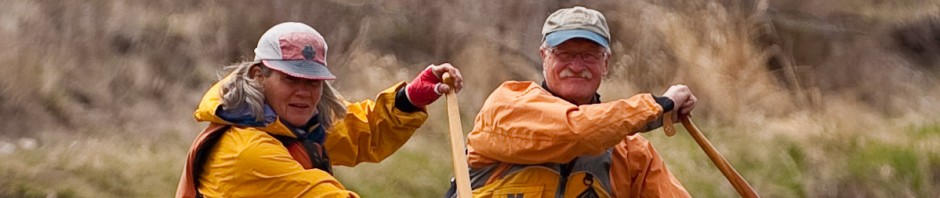
Just yesterday I did it again, this time with Marypat and our niece, Vaughn. I’ve done it 8 or 10 times by now. Much like the East Gallatin you never know what a new run will bring – beaver dams that come and go, sluicing high water or barely doable shallows, bird nests, the calls of sandhill cranes, every bend a door. This time it was only floatable because of recent rains following a very dry winter. Even at that, the channel was barely doable. We startled a moose, several deer, saw western tanagers, eastern kingbirds, yellow warblers, beaver. There were more beaver dams than I’d ever seen, a number of partial dams as well as maybe six full-on barricades that we had to maneuver past. And a surprise ending with a fish-capturing gadget set up just past the takeout bridge that took us by surprise and almost capsized the boats.
It was evening when we took out. The day waned. Cool winds chilled us. And we reveled in the immersion we’d just popped up from, full of life and movement and the sheer momentum of an environment asserting itself in spite of us. A place no one goes. In plain sight. Yet hidden and brimming with magic. My list grows.